
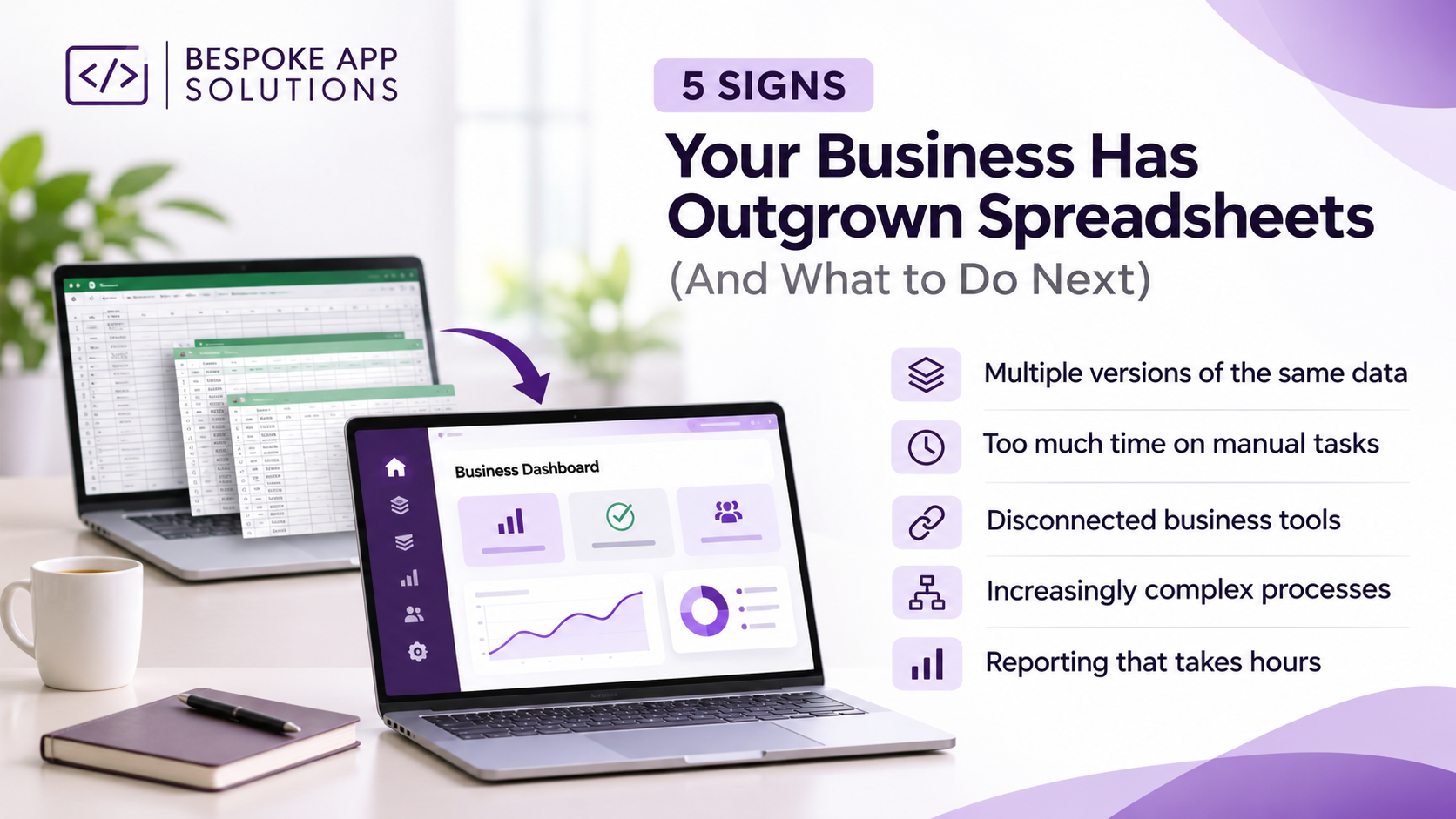
Spreadsheets are excellent tools for managing business information. They’re affordable, flexible, and easy to use.
But as businesses grow, what started as a few simple Excel files can turn into a complicated system of manual updates, duplicated information, and disconnected processes.
Here are five signs your business may be ready for something more.
1. Your Team Is Managing Multiple Versions of the Same Information
Customer details live in one spreadsheet, orders in another, and financial records somewhere else.
When employees constantly copy information between files, mistakes become more likely.
The alternative: A centralized application where teams access the same information, with appropriate permissions for each department.
2. Repetitive Tasks Are Taking Up Valuable Time
Are employees manually entering data, preparing reports, sending reminders, or updating records across different systems?
Even small tasks become expensive when repeated every day.
The alternative: Workflow automation that handles repetitive processes and allows employees to focus on higher-value work.
3. Your Business Tools Don’t Communicate
Many businesses use QuickBooks, CRMs, spreadsheets, and other applications that work well individually but don’t share information.
Employees end up acting as the connection between these systems.
The alternative: API integrations that allow existing applications to exchange information automatically, reducing duplicate work and inconsistencies.
4. Your Processes Have Become Too Complicated
Spreadsheets aren’t ideal for managing multi-step approvals, employee assignments, customer requests, or workflows involving several departments.
As operations expand, tracking responsibilities and progress becomes increasingly difficult.
The alternative: An internal business application that organizes workflows, tracks activities, and gives everyone visibility into the process.
5. Reporting Takes Hours Instead of Minutes
If generating a monthly report means exporting data, combining spreadsheets, and manually creating charts, your reporting process may need improvement.
The alternative: A centralized dashboard that brings important business metrics together and makes reporting faster and more accessible.
Do You Actually Need Custom Software?
Not always.
Sometimes an existing software feature, a better spreadsheet structure, or a simple integration is enough.
But when your business processes are unique, systems don’t communicate, or manual work is slowing growth, custom development may be worth considering.
The goal isn’t to introduce more technology. It’s to make your existing operations simpler, more reliable, and more efficient.
At Bespoke App Solutions, we help businesses achieve that through custom applications, workflow automation, software integrations, and modernization of existing systems.
If your business is spending more time managing its tools than benefiting from them, it may be time to explore a better approach.
Outgrowing spreadsheets and manual processes? Explore our custom software development services to see how Bespoke App Solutions can help.
Leave a Reply